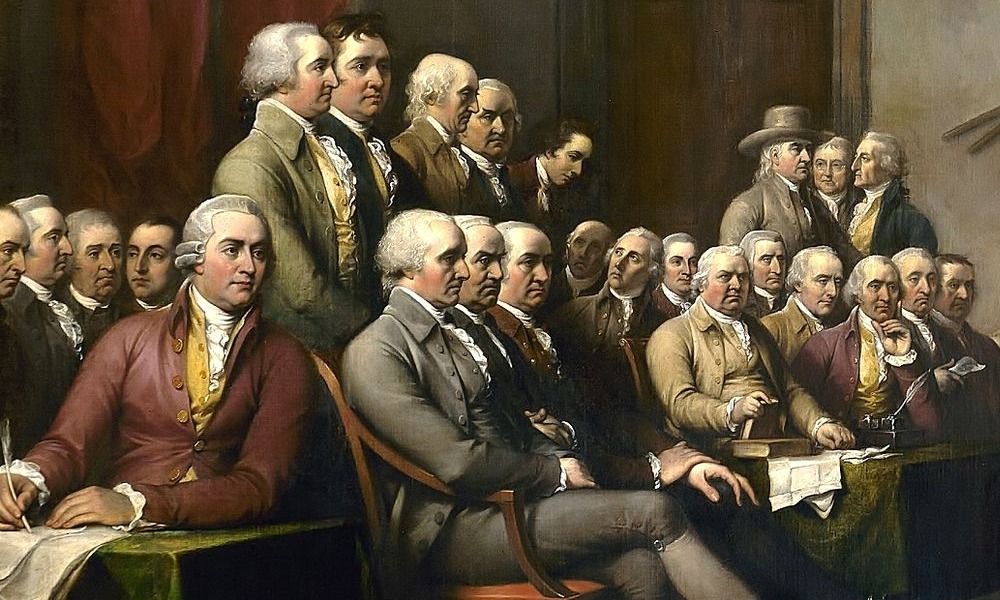
What our Founders Actually Believed: America’s Founders were not guessing when they wrote the First and Second Amendments. They had lived under a government that suppressed speech, taxed without consent, and quartered soldiers in private homes. They designed the Bill of Rights as a direct structural response to specific tyrannies they had experienced personally.
The First Amendment: was influenced by the Magna Carta of 1215, the English Bill of Rights of 1689, and the Virginia Declaration of Rights of 1776. James Madison crafted it to encapsulate fundamental freedoms that he considered essential not just to personal liberty but to self-government itself. Freedom of speech was understood as vital to democracy because without it, citizens cannot hold power accountable. Freedom of the press was considered a “fourth branch of government” providing oversight that no elected body could provide for itself. Unfortunately, in today’s world you actually need to decern what and who are the Free Press.

The Second Amendment: was grounded in the natural law principle that every person possesses inalienable rights, and that the right to forcibly resist infringements on those rights is inherent in self-defense. The Founders understood it as giving “teeth” to the promises of liberty ensuring that attempts to reduce natural rights to mere words on paper could be met with meaningful resistance. Those are not modern political talking points. That is what the Founders wrote and said in their own words.
The First Amendment is the Stronger Claim of the two amendments: it is the First Amendment that has the stronger documented case for being central to American survival and stability. Protected speech under the First Amendment includes political, social, commercial, symbolic, and even hate speech as well as boycotts and the right to receive information. This breadth was intentional. The Founders understood that the speech most in need of protection is never the popular kind it is always the unpopular, dissenting, challenging kind. A government that can silence its critics does not stay accountable for long.
Every major reform in American history abolition of slavery, women’s suffrage, the labor movement and civil rights began as deeply unpopular speech that the established power structure wanted to suppress. The First Amendment kept that speech legal long enough for it to persuade others of its necessity. That was not a small thing. It is arguably the central mechanism by which a democratic republic corrects its own worst errors without collapsing.
The Second Amendment is a More Complicated Claim: Here the honest answer requires some nuance not to diminish the Second Amendment, but to be accurate about what it has and has not actually done over 250 years.
Alexis de Tocqueville, the French political philosopher who studied American democracy in the 1830s, warned that modern democracies drift toward what he called “soft despotism” not violent tyranny but gradual dependence on government that erodes self-reliance and civic courage. The argument for the Second Amendment is that an armed citizenry produces the spirit of self-reliance that makes genuine self-government possible.
That is a serious philosophical argument and it carries real weight. The deterrence theory that government is less likely to overreach when citizens are armed is credible as a structural argument even if it is difficult to prove empirically.
However, there are honest complications:
The Civil War was the most important test case: and it cuts in a complicated direction. The most heavily armed population in American history at the time, the Confederate states, took up arms against the federal government. The result was not preserved liberty but the deadliest war in American history, fought partly to preserve slavery costing between 600,000 and 850,000 lives. Armed resistance to government is not inherently righteous it depends entirely on what cause it serves.
Today’s Modern military reality: has changed the practical calculus our Founders envisioned. The Founders feared standing armies and believed a citizen militia with muskets was a genuine military counterweight to government power. However, in the era of nuclear weapons, surveillance technology, drones, and professional military forces, the practical deterrence value of civilian small arms against a determined federal government is a legitimate debate not a settled question.
The more Durable Deterrence: may actually be the First Amendment working in combination with the Second. A government that fears both armed citizens and a free press, free assembly, and free elections faces multiple overlapping constraints on tyranny. Remove the First Amendment and keep the Second, and you have armed people with no reliable way to organize, communicate, or persuade each other. Remove the Second and keep the First, and you have the model most functioning democracies in the world operate under today and most of them have not descended into tyranny yet.
What Else Has Kept America Standing? To be completely honest the First and Second Amendments are part of the answer, but not the whole answer. Several other structural factors deserve equal credit:
Separation of Powers. Three co-equal branches of government that can check each other has proved remarkably durable. More than once in American history Nixon, attempted court-packing, January 6th the system held not because citizens were armed, but because institutional structures absorbed the pressure.
Federalism. Fifty states, with their own governments, laws, and power bases make it structurally very difficult for any single faction to seize total control because power is too well distributed.
An Independent Judiciary. Courts that can strike down government overreach including by popular majorities have protected minority rights in ways neither the First nor Second Amendment could accomplish alone. However, we have seen in the last decade how biased judges of these courts have the power to bend the law and use it as a weapon.
Geographic Isolation. Unlike European democracies that faced repeated invasion and occupation, America’s physical separation from rival powers gave its institutions time to mature without being destroyed from outside.
Economic Prosperity. Historically, democracies fail most reliably during sustained economic collapse. America’s extraordinary natural resources and economic growth provided the stabilizing foundation that is sometimes easy to overlook.
It is my opinion the First Amendment is arguably the single most important structural guarantee of American liberty, and the Second Amendment provides a meaningful philosophical and practical backstop to it. Together they reflect the Founders’ hard-won understanding that free people must be able to speak, organize, publish, and if necessary resist both internal and external forces and that any government that can silence or disarm its citizens without constraint becomes something other than a republic.
The First Amendment and Second Amendment were understood by the Founders as inextricably linked regulation and liberty were not opposites in forming of our constitution but complementary concepts, with both amendments working together to preserve the peace and protect our freedoms.
America’s 250-year survival is not the product of any single amendment working alone. It is the product of a system deliberately designed with overlapping, redundant constraints on power of which the First and Second Amendments are two of the most important, but not the only ones. The day any single safeguard is relied upon exclusively to protect our rights is the day the others quietly begin to erode.
Over the past decade we have seen these two amendments of our constitution tested time and again in our judicial system but both have supported by our Supreme Courts Decisions.
It was Joseph de Maistre who said “Every nation gets the government it deserves. However today I think that the words of Thomas Jefferson are more appropriate as he said “The Government you elect is the government you deserve.” Our voting system needs to be secured so that only American Citizens are permitted to cast ballots in our elections. Call your representatives today and make sure that they vote yea on the Save Act.
“We Get the Government We Deserve”

One reply on “Why America has Survived as a Republic for 250 Years”
An interesting and thoughtful analysis concerning the First and Second Amendments, Bob. I would like to mention that when the British marched to Lexington and Concord, they were tasked with seizing storehouses of powder and arms. They were not sent to seize supplies of parchment, ink, or quills. Both amendments are critical to our Republic. Tyrants and despots fear both….but not equally, nor for the same reason.