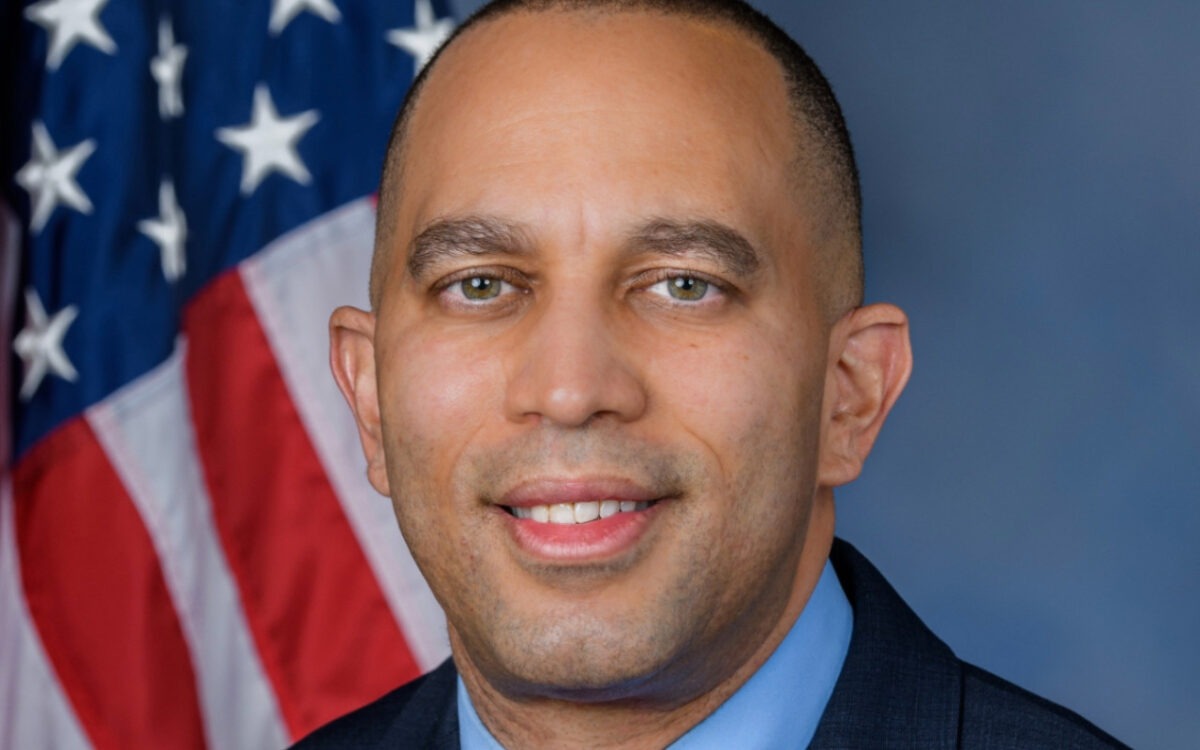
The episode with Hakeem Jeffries’ comments about SEC football did more than make a headline; it revealed how casually some political leaders are willing to turn individual lives into instruments of their own power.
Two days ago, on May 19, Jeffries urged Black athletes to boycott universities in the Southeastern Conference (SEC) whose states he accused of deploying “Jim Crow‑like, racially oppressive tactics” in redistricting. This was not an offhand remark. His message was explicit, repeated, and framed as a historic call to action:

“This is an unprecedented moment, featuring an unprecedented attack on Black political representation, and therefore it requires an unprecedented response,” and the response he demanded was clear:
“We are here standing in solidarity with the NAACP and its call for athletes to boycott institutions within the SEC that belong to states that have unleashed these Jim Crow‑like, racially oppressive tactics, which is unacceptable, unconscionable and un‑American, and we believe that the silence of these institutions is complicity, and we will not stand for it.”
Strip away the moral drama and what remains is a sitting member of Congress, and the House Democratic leader, calling on young men and women—many from modest or poor backgrounds—to sacrifice opportunities for education, development, and generational wealth in service of a political strategy they did not design and cannot control. That tells you something about priorities. It suggests that holding and increasing political power ranks higher than protecting the futures of the very people whose interests these leaders claim to represent.
I played Division III football in Ohio in the late 1960s and early 1970s. I remember when the Big Ten and Big Twelve began recruiting Black players while the SEC remained lily‑white. Northern programs—including small colleges—benefited directly from the racial prejudices entrenched in the South. At Wittenberg, we had Black basketball, football, and baseball players who, by any rational measure of talent, could have been on Division I rosters in the South but never got the chance because those programs were still segregated. They came north, and they thrived, not because of some enlightened northern virtue, but because southern prejudice closed doors that should have been open.
The story of SEC integration is not ancient history. The first Black football player to appear in an SEC game was Nate Northington at the University of Kentucky, who played against Ole Miss on September 30, 1967. Northington and his teammate Greg Page—who tragically died after a practice injury—were pioneers who endured isolation and hostility to break down the color barrier in SEC football. They opened the door for thousands of Black athletes who followed.
Legal and economic pressures pushed that door wider. After Brown v. Board of Education and especially after the Civil Rights Act of 1964, southern universities faced growing legal and financial pressure to integrate not only their student bodies but also their athletic programs. At the same time, the best Black athletes from the South were heading either to Historically Black Colleges and Universities (HBCUs) or to northern and western schools. The racially “pure” rosters of the old SEC were increasingly uncompetitive.
Then came September 12, 1970: integrated USC, led by Black star Sam Cunningham, went into Birmingham and beat all‑white Alabama 42–21. That game became a symbol and a turning point, a living demonstration that if the SEC wanted to compete on the national stage, it had to recruit Black athletes. The legend is that Cunningham “integrated Alabama in one afternoon.” That’s an exaggeration, but it captures a truth: opportunity for Black athletes expanded when institutions finally confronted their own self‑interest and the legal and moral realities of the era.
From that long and painful process, a new world of opportunity emerged. For countless young Black men—and later women—athletic scholarships to SEC schools became tickets to something far larger than football: a college education, access to professional networks, and, for a select few, the possibility of generational wealth. Even for those who never sniffed the NFL, the discipline, visibility, and degrees they earned changed the trajectories of their lives and families.
Now imagine being the parent of such a young man or woman today. Your child has a chance at a full scholarship at a major SEC program. That scholarship may mean being the first in your family to graduate from college. It may mean an engineering degree, a business degree, a pre‑med track—combined with coaching, discipline, and a community that will shape their character for life. Are you really supposed to look at that opportunity and say, “No, my child will walk away from this so that a member of Congress can make a political point”?
That is effectively what Jeffries is asking. He is not offering to bear any real cost himself. He is not giving up his position, his pension, or his future. Instead, he is urging teenagers and young adults—most of whom come from families far less secure than his—to throw away hard‑won opportunities so he and his allies can send a message in a redistricting fight.
If he truly believed in that logic, why stop at athletes? Why not call on Black students in SEC law schools and medical schools to drop out? Why not ask aspiring Black doctors, lawyers, and engineers to set fire to their own futures in order to dramatize his view of redistricting maps? And would he have done the same at the critical moments of his own life? Would he have walked away from his own education, his own path to leadership, for a symbolic boycott? It is easy to be radical with someone else’s future.
This is the deeper pattern: the political left, at least in its current form, routinely treats human beings as group tokens—voting blocs to be mobilized, “communities” to be inflamed, classes to be pitted against each other. Individuals disappear into categories: Black athletes, working‑class voters, women, immigrants. These categories are then moved around like pieces on a chessboard to create pressure, chaos, and conflict that can be leveraged into political gain. The people who pay the price are almost never the ones issuing the calls to sacrifice.
Politicians like Jeffries have no skin in this particular game. If Black athletes boycott SEC schools, it is not Jeffries’ son who loses a scholarship, or Jeffries’ daughter who misses out on a medical degree, or Jeffries’ family that forfeits the chance to escape generational poverty. The costs fall on families whose lives could have been transformed by the very opportunities he is asking them to reject. He keeps his seat. They lose their shot.
This is not courage. It is not moral leadership. It is a form of moral exploitation—using the aspirations of young people as fuel for a political narrative. So many politicians fit the same pattern: they ask you for your vote, and then, when it suits them, they ask you to put your future at risk so they can climb another rung on the ladder.
In my judgment, there are few things more despicable than telling a young person to throw away a life‑changing opportunity in order to serve someone else’s long‑term political strategy. The struggle to integrate SEC football was about opening doors that had been unjustly closed; the current calls for boycotts would slam those doors shut again, not for the sake of justice, but for the sake of power.