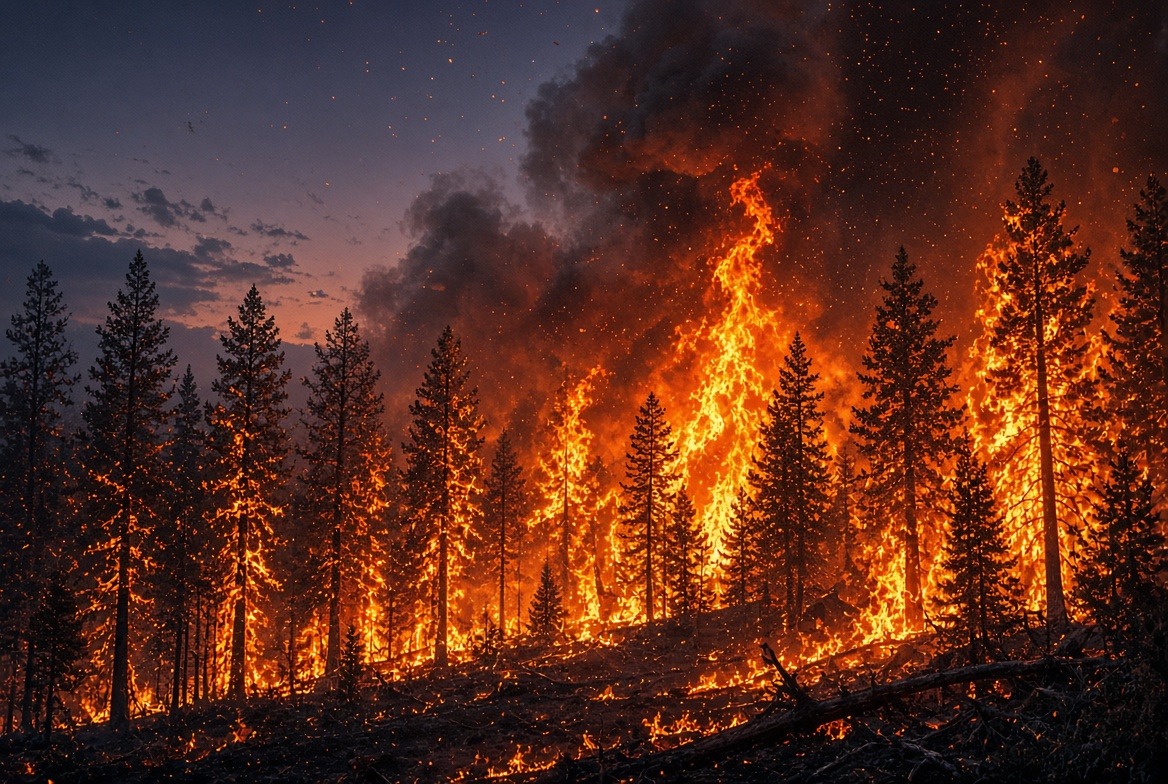
I have lived in Idaho my entire life. I’d tell you about its unmatched beauty, its tight-knit communities and the peace and safety we’re blessed to have, but that would encourage more people to move here and we have more than enough people moving in as it is. In Fact, the only thing that prevents Idaho from being a near-utopian location is the willful arson of the American West. A policy that has been burning through millions of acres, hundreds of millions of dollars, and the health and wellness of its residents. The subject is a difficult one to broach for several reasons. The first being you sound certifiably insane when you tell people what is happening as the firefighters are starting fires. The second being that any criticism of the new-age-way of firefighting is viewed as a criticism of the brave firefighters themselves. It’s an unfortunate tactic used to try to silence debate on important issues. Complain about any problems with how the TSA runs? You’re spitting in the face of hard-working Americans. Any critique of COVID policy was an attack on frontline doctors working diligently during an epidemic. The tactic works really well, especially if you’re far enough away from the problems the policies create.
Unfortunately, in Idaho, we’re all too close to the disaster created by federal firefighting policy, which has veered further and further away from allocating resources to extinguish fires and toward allocating more resources to starting them. If you don’t live around here and think that sounds insane, understand that it is insane, but all too real to those of us who live here. The fire seasons in the west have grown worse over the last twenty years, leaving many Idahoans asking their family and friends, “It Wasn’t always like this, was it?” The arson of our national forests has come with a heaping dose of one of Gen Z’s favorite buzzwords, gaslighting. No, it wasn’t always this bad, and fire season didn’t magically turn into months-long hazes driving people even a hundred miles away indoors in search of some clean air. It was never like this with ash falling from the skies, eyes burning and lungs struggling to breathe. A policy change brought this demoralizing reality to fruition, and it started in 1978.

The Forest Service firefighting strategy since 1935 was known as the 10AM policy. It stated that a fire must be aggressively attacked and extinguished by 10 AM the morning after it was spotted. The policy was applied time and again to raging forest fires across the Pacific Northwest. When I discovered this history, it blew me away. Just think of the technology they had at that time compared to what we have today. We should have a 5AM policy with all of the helicopters and big machinery we are lucky enough to have at our disposal, but our fires burn and burn for weeks and months on end. How? Why? Well, because our firefighters don’t fight fires; they start them. And no, we don’t have rogue arsonists going around doing this. These firefighters are trained to do this.
U.S. Forest Service Policy changed in 1978 when chief of the Forest Service, a man named John R. McGuire, declared that wildfires were a part of nature and not a foe to be extinguished. Where did he get that crazy idea? Well, he traveled to the Soviet Union in 1973 as part of a scientific delegation and, in turn, he hosted a Soviet Union Forestry Delegation in the U.S. at the height of the Cold War. The Soviet Scientists exchanged forestry data and findings with him, and the U.S. did the same. This was one of the factors that informed and shaped his view that our forest management policies must change because of the data sets from a country we were at war with. One man, one chief of the Forest Service, had the power to rewrite half a century of tried and tested fire policy. He even changed the agency’s vocabulary from “fire suppression” to “fire management”. It was no longer the policy to suppress fires, but to let them burn.
He did more than that; he introduced the concept of “fire by Prescription” under his guidance. The Forest Service fire policy went from extinguishing every spark to setting “little” fires on their own. As of today, “burnout”, is the tactic of intentionally setting fire to all possible fuel in an area before a wildfire can reach it, is widely used. This has turned out to be an absolute catastrophe. Federal crews come into an area already burning and don’t attack the flames, but instead start fires, not just on national forest land, but on private Property. Waling along with drip touches, causing unimaginable harm to the people who live there, especially the ranchers of the West. Cattle, barns, feed and old homesteads have gone up in a cloud of smoke, not started by lightning or a spark on the highway, but by the very agencies our tax dollars pay to prevent fires. You want to know why your steaks are so expensive? The federal government’s policies are burning the cattle’s feed.
Ranchers have been met with threats when confronting crews setting fire to their property. The policy is unrelenting; if a private property owner tells them to leave, they threaten to make the owner legally liable for the full destruction of fires in the area. Mob tactics, documented not by rumor, but by local sheriffs. This has to stop. If one man in 1978 can change the Forest Service’s goals from aggressive extinguishment to aggressive prescription fires, than surely, in 2026 the current fire chief can do a 180 and reimplement the 10AM policy. Areas that are overgrown can be cleared in numerous ways besides fire, the most extreme and dangerous way to clear undergrowth. We have the technology to fight fires safely AND MORE EFFICIENTLY THAN EVER BEFORE. In 1978 it was a debate whether this new way of thinking was the best way to manage forests; in 2026 there is no debate. Fire seasons are more destructive, and summer air in the Pacific Northwest is more polluted than ever. The forests are disappearing. The American people are sick from breathing in thick smoke. A policy brought us here, and a policy change can get us out. We just need someone with the will to do so. Michael Boren is the undersecretary of agriculture for natural resources and environment who oversees the U.S. Forest Service. He has a 480 acre ranch in the Sawtooth national recreation area and recently had a fire that threatened his property. It is high time that Mr. Boren acted to fix the Forest Service policy of putting out fires instead of their burning policy.


2 replies on “Op-Ed: Arson of the American West”
Every word he said is true. Lived here my whole life. The BLM and the Forest Service are NOT our friends.
The Sweet – OLa Complex fire years ago was like this. The locals had it amost out when the “gubment” rolls into town and orders everyone back. They then proceed to burn everything up. 56,000 acres
The Soda fire in Owyhee County more recently was the same. Local ranchers had it almost out, the BLM rolls in and threatens to jail everyone if they extinguish it. Ranchers back off and the BLM lets it go. 280,000 acres
The fire up near Redfish Lake in the Stanley area is another example. Started out first couple of days just hundreds of acres. Oh, but they couldn’t be bothered to fight it aggressively. It burned thousands and thousands of acres. Go drive up there and look at the damage it caused. With no trees left on the mountains it’s landslide central up there.
And now the Big Grass fire that started in Oregon east of the Owyhee River. Locals were fighting it, didn’t have it under control yet, but were getting there, when the “gubment” takes over. And the “gubment” does absolutely nothing for four and a half days, allowing the fire to build back up to an uncontrollable monster that jumped the canyon and then raged uncontested through the the Owyhee backcountry destroying seven generations worth of hard working family ranches.
Tellingly, when the fire reached the Duck Valley Indian reservation the Department of the Interior called in eighteen tanker planes and helicopters and put it out in under a day.
But until the fire hit Indian territory those tankers were not available. Yeah, right.
And yes, both out in the Owyhees and in the fire near Weiser, the BLM firefighters were setting fires all over private property, effectively burning the ranchers off of their own lands.
Our “gubment” is at war with We the People.
Bravo to the author of this piece. A primary issue with these “wild fires” in Idaho is the fact that thousands of residents here make their living getting paid to watch the forests burn while doing little or nothing to fight fire. People are getting rich being paid to “work” fires. We being tax payers are actually supporting arson of our forests.