
In Blackfoot, We Have A Problem Part 1, a general introduction was given about a development issue in Blackfoot. Details in the article focused on the potential development’s density, state statute violations, Comprehensive Plan (CP), overburdened water and sewer system, and the Blackfoot Planning and Zoning Commission (PZC) not addressing any of those issues in an accountable way.
While the following may seem tedious, it leads up to the larger understanding of why a local government can behave irresponsibly. This discussion will focus on required laws for any development in Idaho.

Idaho Statute, IC 67-65, outlines laws for land development that cities and counties must follow. Several areas are covered such as CP requirements, zoning laws, planning and zoning responsibilities, and how development is to be accomplished.
IC 67-6511 defines how zoning ordinances are created. These zoning decisions are mandated to consider consistency with the CP, gather input from public hearings. and notify surrounding residents for any zoning changes. City or county ordinances must not be “in conflict” with the CP.
Three state statutes are in play with any proposed development. IC 67-6513, Subdivision Ordinance, states the application process for a subdivision is outlined in IC 50-1301-50-1329. Also mentioned is that a local ordinance “may provide for mitigation of the effects of subdivision development”, which means how the municipality will prevent any negative impacts the development will have in its ability to deliver services ” without compromising quality of service delivery to current residents or imposing substantial additional costs upon current residents to accommodate the proposed subdivision”. As detailed in Part 1, there will be substantial costs to current Blackfoot residents as a result of the proposed subdivision, especially in water and sewer delivery because of needed upgrades.
Moving on, IC 67-6515 Planned Unit Developments (PUD), is an “area of land in which a variety of residential…and other land uses are provided” under single ownership. PUD ordinances may include minimum area requirements, permitted space, open space, density, and other components. The important issue here is the code states a PUD “may be permitted pursuant to the procedures for processing applications for special use permits“, meaning a special use permit, also called a Conditional Use Permit (CUP), must first be granted in order to apply for a PUD.
IC 67-6512 Special Use Permits, Conditions, and Procedures describes the CUP requirements, again requiring a public hearing prior to approval (b). If approved, a CUP may have conditions attached to it such as minimizing adverse impacts on other development; controlling the development sequence, timing, and duration of the development; designating the exact location and nature of development; and mitigating the proposed development’s effects on service delivery (8).
These statutes are intended to protect communities and guide responsible growth. As explained in Part 1, the proposed Blackfoot development would have adverse economic costs and environmental effects on residents.
Understanding state statutes on Subdivision, PUD, and CUP development, the question is how the Blackfoot PZC and City Council did not follow the law.
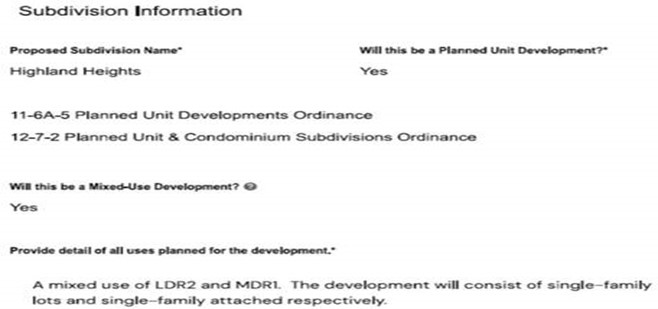
The applicant was directed to submit a Subdivision Application (12-2-4) that would be a PUD (11-6A-5) and a Planned Unit & Condominium Subdivision (12-7-2), with no CUP application. This application, thereafter referred to by the PZC as a PUD application, begins the long trail of not following state statutes or even Blackfoot code.
The development would include 20 LDR2 single family homes and 128 MDR1 townhomes. Even the applicant erroneously stated only two types of housing was allowed in an MDR1 zone and they are not apartments or high density type structures. Clearly, four attached town homes in one unit on a .25 acre lot is high density and has an adverse impact on the community. Assuming a minimum of two persons per townhome, that is 32 individuals living on a one-acre lot.
More appalling, the City has a Subdivision flow chart that just bypasses CUP and PUD statutes and ordinances. Contained within that chart is a link that goes to Blackfoot Title 11 Zoning Regulations, which under 11-1-2 outlines the purpose to promote the health, safety and general welfare of the people of the city; ensure that adequate public facilities and services are provided…at a reasonable cost; and avoid undue concentration of populations and overcrowding of land. Another zoning ordinance, and state statute, out of compliance.
The City of Blackfoot does have a CUP ordinance (11-6A-4) and under the PUD code, 11-6A-5-D1, a CUP can be submitted in one of two ways, however this was not done.
The PZC held the first public hearing on this Subdivision, a.k.a PUD, application on October 28, 2025 where the majority were in opposition, however the meeting minutes are incomplete. The PZC approved the application but because the hearing date was incorrectly posted, a re-hearing was scheduled for December 9, 2025. That hearing was cancelled due to Idaho Department of Environmental Quality (IDEQ) concerns about “placing storm water infiltration components in a manner that could increase groundwater flow into the footprint of the former landfill” on the development. This snag prompted another hearing.
IDEQ dismissed its concerns after talking with the applicant so the next PZ public hearing was held on February 24, 2026, following multiple appeals against the PZC decision, and again with majority opposition. PZ Director, Travis Allen, calling it a PUD, read the “Findings of Fact” report which contained multiple errors, then claiming “The information provided in the application is largely the same for the Planned Unit Development and the Conditional Use Permit.” Sure, the law says codes can be mixed and matched. The PZC “voted to recommend to City Council to approve the request for the Planned Unit Development” with recommendations for a physical traffic and water study “at the tap”.
At the April 7, 2026 City Council meeting, without addressing any of the public appeals or concerns about code violations in writing or at the meeting, and omitting the traffic and water study, the application was approved.
If all of this sounds dreary, it is important to understand because the courts uphold this nefarious behavior by local municipalities.
In Reese v City of Blackfoot, the Petitioner had requested a Judicial Review regarding a PUD approval in a “Residential Ranchette” zoning district, a code violation. Regardless, the 7th District Court “dismissed their petition for judicial review” because the Petitioners “did not demonstrate prejudice to a substantial right.” In other words, the Petitioner lost the case because, in spite of the City violating codes, they failed to prove potential harm as a result of those violations. This is called prejudice to a substantial right under IC 67-5279.
The case was then appealed to the Idaho Supreme Court (ISC).
ISC upheld the 7th District Court decision, outlining it on page 4: “The district court held that while the City did in fact violate its own code by approving the PUD, the Reeses failed to show prejudice to a substantial right as required under Idaho Code section 67-5279(4).” “…the district court held that conclusory allegations of harm were not sufficient to establish prejudice to a substantial right.” Violating state statutes and municipal codes is allowed because the Petitioner did not prove harm as a result of those violations. Decisions in similar cases have been the same and municipal decisions “are entitled to a strong presumption of validity.”
Every reader should take note regarding this ISC decision as it affects every person in Idaho. Anyone that challenges a municipality for code violations will lose unless they can show factual harm as a result of those code violations. The burden is on the citizen to prove harm while the municipality goes unpunished for breaking the law.
A substantial right “refers to a fundamental and significant legal entitlement that directly affects a person’s core interests, property, or liberty.” Prejudice to a substantial right means harm was caused by an agency action, and in the Reese case, the Court found the Plaintiff provided no proof of harm, or potential harm, even though multiple code violations did exist.
So any local government in Idaho can violate codes til the cows come home and if there is no “direct” harm to anyone as a result of those violations, they can continue to violate them. It is only an applicant who can oppose decisions on code violations, but if those violations are in their favor, why would they ever challenge them as in the case of the Blackfoot development.
It also makes it very easy in the Blackfoot case to ignore appeals as City Attorney Garrett Sandow was involved in the Reese case, and he understands the code violation and other arguments opposing the Blackfoot development are similar to the ones cited in the Reese case. And so does the Blackfoot PZC, PZ Director, City Council, and former PZC Chair and current Mayor who cast the tie breaking vote that approved this development.
Those failed arguments included increased density; potential for transient home ownership or rentals; safety of children; limited access to emergency services; and increased traffic through a neighborhood. The ISC found none of these concerns as potentially harmful.
Part 3 in this series will take a closer look at how Blackfoot will be damaged by this development, the impact it will have on citizens, and how the officials involved in this decision have failed in their responsibilities to those citizens. Hopefully, it will also give all Idahoans a better understanding as to why they need to become engaged with their local officials and monitor their adherence to the law.





One reply on “Blackfoot, We Have A Problem – Part 2”
Take time to look at the C40 CITIES. It’s all about climate. I don’t think what’s going on here in Idaho is by accident, they are doing this by design.