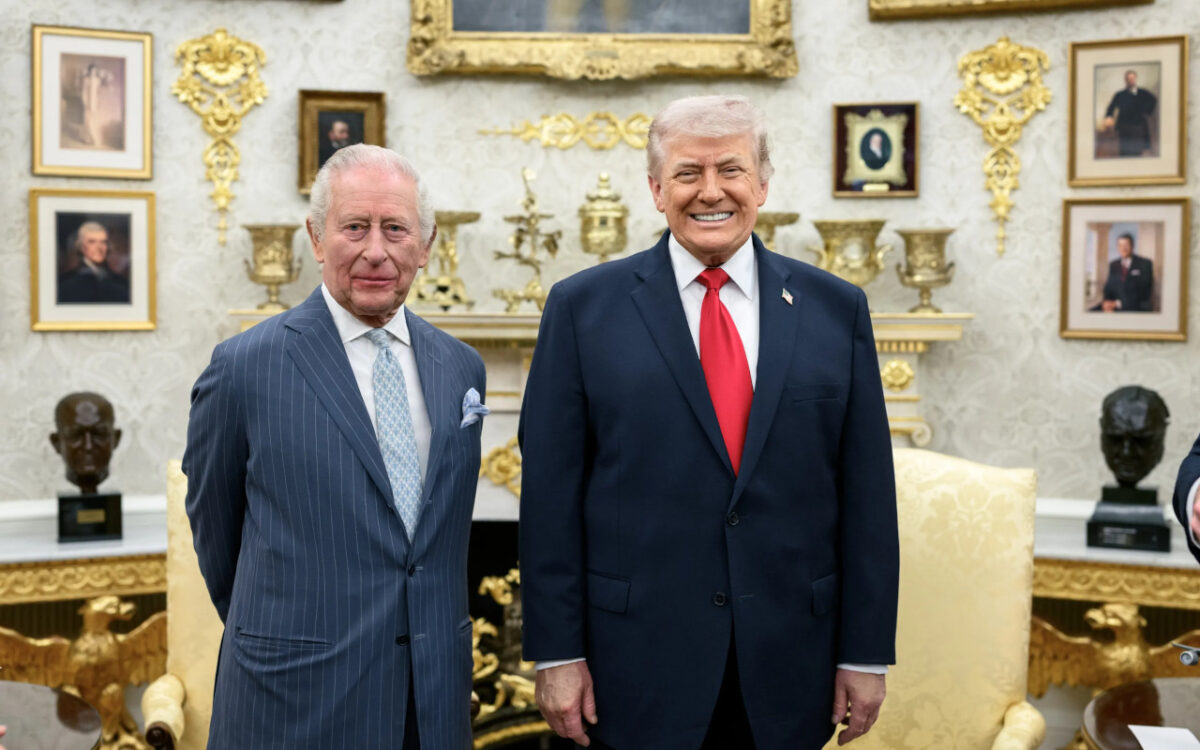
Over the past several days, I found myself unexpectedly drawn to the events surrounding King Charles III’s state visit to the United States. As someone never particularly sympathetic to monarchy, I approached his appearances with skepticism. Yet I was pleasantly surprised by the tone and substance of his two principal speeches—one at the White House and the other before Congress. Both were thoughtful, measured, and carefully crafted. Still, they have prompted a deeper reflection, especially after reading several critiques, including one by an Anglican priest in England, to which I partially respond.
A meaningful way to evaluate King Charles’s remarks is to compare them with the wartime speeches of Winston Churchill, particularly his address at the White House on December 24, 1941, delivered alongside President Franklin Roosevelt. That moment marked not only a military alliance but a moral declaration. Churchill made explicit that the unity between Britain and the United States was grounded in a shared Christian faith and a common civilizational inheritance. The subsequent wartime addresses by both leaders—often called the “Alliance speeches”—continued from 1941 to 1945 and consistently articulated this shared vision.

Together, Roosevelt and Churchill framed the Anglo-American partnership as a moral union rooted in what might be called the Christian Enlightenment. Their rhetoric blended Biblical language with Enlightenment political philosophy, presenting the struggle against tyranny as both a moral and civilizational imperative. These speeches were saturated with a vocabulary drawn from Scripture, natural law, and classical philosophy—an inheritance stretching from the Hebrew prophets through Athens and Rome, through Magna Carta and the British Enlightenment, and culminating in the American founding.
Three core ideas animated this tradition. First, Christian universalism: the belief that human dignity, justice, and moral law are objective and binding. This principle is expressed most clearly in the Declaration of Independence, which asserts that all men are created equal—an explicitly theological claim grounded in the belief that humanity is made in the image of God.
Second, Enlightenment political theory: the conviction that natural rights, constitutionalism, and the rule of law arise from these moral predicates. The American founding did not invent these ideas but codified them, drawing from a long intellectual tradition that fused Judeo-Christian ethics with classical philosophy.
Third, the belief that nations themselves are accountable before God for the moral use of power. Roosevelt frequently invoked Providence and described democratic nations as stewards of freedom, charged with resisting aggression and defending liberty not merely for themselves, but for the sake of a broader moral order.
When Churchill stood beside Roosevelt, the symbolism was unmistakable: two nations joined not only by interest, but by a shared moral heritage and purpose.
King Charles’s speeches, though delivered in a very different context, also drew from this same philosophical and moral tradition. Yet the contrast in emphasis is striking and revealing. Where Churchill spoke in a time of existential war against a clearly defined evil, Charles spoke to a world marked less by singular tyranny than by fragmentation, pluralism, and cultural dislocation and ambivalence.
His language was notably pastoral and ecumenical. He emphasized interfaith dialogue, mutual understanding, and reconciliation. His imagery—particularly that of “light over darkness”—was not framed as a call to confront and defeat evil, but rather as an appeal to bridge divisions and cultivate harmony.
This difference is not merely stylistic; it reflects a deeper divergence in how moral leadership is expressed. Churchill’s rhetoric was grounded in the conviction that evil must be named, confronted, and defeated. His invocation of Christianity was not abstract or symbolic—it was a call to moral clarity and action, even at great cost.
By contrast, King Charles offered a model of leadership oriented toward dialogue and coexistence. His approach reflects the realities of a pluralistic world, where consensus is fragile and unity often depends on restraint and mutual recognition.
Both approaches have merit, and both draw from the same underlying tradition. The Anglo-American inheritance requires not only the courage to confront evil but also the wisdom to seek peace. Yet these are not interchangeable priorities. Dialogue is a means, not an end. When fundamental moral goods—especially liberty—are threatened, the first obligation of leadership is clarity.
This is where King Charles’s otherwise admirable remarks fall short. In emphasizing unity and reconciliation, he avoided naming the most pressing forms of contemporary evil. Most notably, he did not address the rise of theocratic Islamist totalitarianism, a force that directly challenges the principles of ordered liberty, religious freedom, and human dignity that both Britain and the United States have historically defended.
This omission matters. The Anglo-American tradition, rooted in both Biblical and philosophical sources, consistently affirms that confronting evil begins with naming it. Scripture itself offers countless examples of flawed individuals—prophets, kings, apostles—who were nevertheless called to stand against injustice and oppression. They did so not by obscuring moral distinctions, but by clarifying them.
To defend what the American founding rightly understood as God’s gift of liberty—what might also be called the exercise of free will—requires more than eloquence or goodwill. It requires the willingness to identify threats plainly and to act accordingly.
King Charles’s speeches were graceful and well-intentioned and pastoral. They reflected an admirable desire for unity in a fractured age. But the Anglo-American tradition he invoked demands something more: a balance of compassion and courage, of diplomacy and moral clarity.
Bridges are essential. But they must lead somewhere. And when liberty itself is at stake, the first duty of leadership is not merely to build bridges, but to stand firm against the forces that would destroy them.