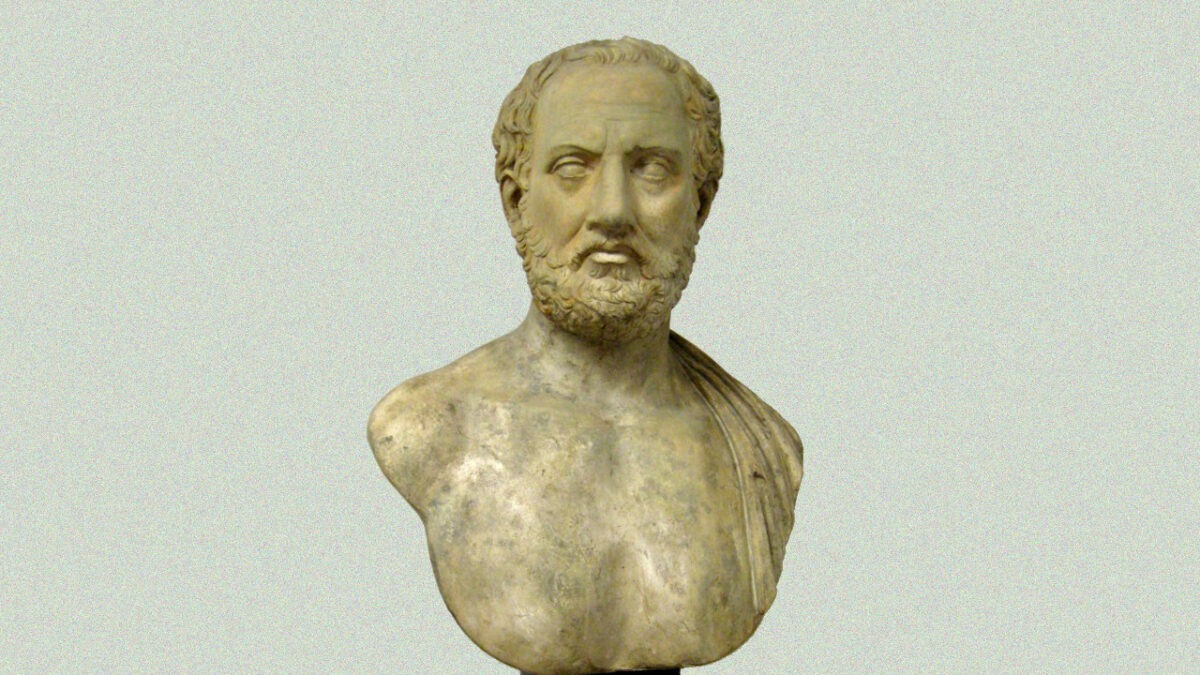
The mainstream press has been clamoring about Xi Jinping’s remarks to President Trump regarding the “Thucydides Trap.” Commentators have rushed to interpret the phrase as a new, ominous warning, with one “expert” suggesting that Xi would never have dared speak in those terms had he not been emboldened by American weakness.
According to the New York Times, Xi’s recent words to President Trump were:

“The world has come to a new crossroads. Can China and the United States transcend the ‘Thucydides Trap’ and forge a new framework for relations among major powers?”
\Presented this way, the casual reader could be forgiven for thinking this phrase was coined for Trump, or that it signals some new level of Chinese confidence in American decline. In reality, Xi has used this language for years, addressing it to several American administrations and to other foreign leaders as well. As has been reported, back in 2013 Xi told international leaders: “We need to work together to avoid the Thucydides Trap, which is a destructive tension between emerging powers and existing powers, or between two existing powers.” Those words were first spoken when Barack Obama was president of the United States, long before the current media cycle discovered them.
The “quote from Thucydides” to which Xi alludes distills a sober insight from the History of the Peloponnesian War: that it was “the rise of Athens and the fear that this instilled in Sparta that made war inevitable.” The warning is straightforward: when a rising power provokes fear in an established power, the resulting insecurity and miscalculation can drag both into great‑power war—unless the dynamic is consciously checked. When Xi invokes the Thucydides Trap, he is not merely performing for the cameras; he is signaling how he understands the strategic relationship between China and the United States.
From the vantage point of an external observer looking at our domestic political turmoil, it would not be difficult to conclude that America is drifting into precisely the kind of weakness that would tempt ambitious rivals. I would go further: it has been Donald Trump, more than any other recent American leader, who has meaningfully altered that trajectory since Xi first began invoking this phrase. Xi is watching not only our military posture and economic statistics, but the resolve of the American people. He senses weakness when we doubt ourselves, and strength when we rally behind a leader who is willing to confront him in terms he understands.
History offers a useful metaphor. Alexander the Great is often credited with saying he would rather face a pack of wolves led by a lamb than a herd of sheep led by a wolf. For roughly 250 years, Americans have been that pack of wolves—fierce, independent, and dangerous when roused—led, at crucial junctures, by leaders who seemed to appear just when the nation most needed them. In recent decades, however, from George W. Bush through Barack Obama and then Joe Biden, we have too often been a strong people led by lambs.
Now we face a different situation. We once again have a strong leader at the head of a strong people. That is what truly alarms Xi Jinping. He is a patient man, and no stranger to historical thinking, but all is not well within his own country. China faces economic strains, demographic decline, and internal discontent. Men like Xi understand only the language of strength. Communist dictators rise and rule through fear and coercive subjugation; there has never been an exception to that pattern, and Xi is certainly not the first to fit it.
That is why it is encouraging that President Trump has not flinched in the face of Xi’s repeated, thinly veiled references to the Thucydides Trap. The appropriate response to such a warning is not panic, nor is it capitulation. It is steady, disciplined strength—moral as well as military—backed by a people whose confidence is rooted in something deeper than economic output or technological prowess.
Rudyard Kipling, in his poem “Recessional,” wrote at a moment when the British Empire was beginning to crumble under the weight of its own bureaucratic imperialism. His warning still applies:
“O heathen heart that puts its trust
In reeking tube and iron shard,
All valiant dust that builds on dust,
And, calling, calls not on the Lord.”
Kipling’s point was not that arms and industry are unimportant, but that any empire—or republic—that trusts only in its weapons and institutions, while abandoning the moral and spiritual truths that once animated it, is already hollow at the core. When nations forsake biblical and natural‑law truths, they eventually fail. That has been the pattern across the ages.
Our strength has never resided solely in our GDP, our aircraft carriers, or our nuclear arsenal. It lies in our Greco‑Roman and Judeo‑Christian inheritance: the conviction that there is a moral law above the state, that human beings are endowed with inalienable rights, and that rulers themselves are accountable to a higher standard. If we do not return to those principles—if our current Great Awakening falters and we continue to erode our own foundations from within—then China will not need to fire a shot. The internal damage wrought by progressive ideologies and policies will be sufficient to ensure that America yields ground economically, politically, and ultimately militarily.
Kipling concluded with a plea that should be ours as well:
“God of our fathers, be with us yet,
Lest we forget—lest we forget.”
That is the crux of our present crisis and the answer to Xi’s calculated invocation of Thucydides. The question is not only whether America and China can avoid the Thucydides Trap in some abstract, geopolitical sense. It is whether the American people still have the resolve to stand against totalitarianism, as we did when we saved the world from Fascist regimes in WWI and II and when seven hundred thousand young lives were sacrificed to destroy the evils of slavery and fulfill the promises of our great Founding Documents.