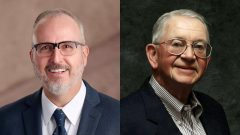

Bob Neugebauer and Dylan Stocker take a hard look at Idaho’s 2025 legislative session on The Idaho Pulse, examining how the governor’s post-adjournment veto power undermines bills that passed with strong legislative support. They break down the procedural mechanics — from the constitutional 10-day veto window to Senate committee structures — that give a small group of leaders outsized control over which legislation survives and which quietly disappears.
The conversation follows the money behind Idaho politics, with Stocker detailing specific IACI donors including Melaleuca, Micron, Pfizer, and Johnson & Johnson, and connecting those contributions to Governor Little’s veto of the 2025 Medical Freedom Act. Neugebauer traces the state’s growing dependence on federal funding — now roughly 40% of a $14.35 billion budget — and warns that unfunded mandates loom when that money runs out. Both hosts point to the state’s 189 agencies and $150 million in corporate tax exemptions for Meta, Google, and Amazon as evidence of spending priorities that favor large institutions over Idaho taxpayers.

Neugebauer and Stocker assess potential future governors — naming Russ Fulcher, Raul Labrador, and others — and propose practical steps for voters, including researching candidate donors at sunshine.voteIdaho.gov to distinguish PAC-funded incumbents from grassroots challengers. The episode closes with a frank discussion of the U.S. military campaign in the Middle East, the strategic importance of the Strait of Hormuz, and what the deployment of Idaho-based A-10 Warthog units means for the state’s military families.
0:01 Introduction to The Idaho Pulse with Dylan Stocker
Bob Neugebauer welcomes Dylan Stocker of The Great Idaho Show to The Idaho Pulse, previewing a two-part conversation covering the Idaho legislative session and the ongoing conflict in the Middle East.
0:42 Governor’s Post-Adjournment Veto Power and the Gentleman’s Agreement
Stocker opens with what he calls procedural malfeasance in Idaho’s constitution — the governor’s ability to veto bills up to 10 days after adjournment, when overriding requires a 60% majority that legislators cannot assemble because they have already gone home. He references House Speaker Mike Moyle’s claim of a gentleman’s agreement with the governor’s office on post-session vetoes. Neugebauer connects this to the Senate’s pocket veto structure, where 22 members — 9 chairmen, 9 co-chairmen, and 4 committee chiefs — effectively control what legislation advances, a built-in blocking mechanism that functions independently of the full chamber’s will.
5:02 Idaho’s DOGE Committee and the Legislative Power Structure
Neugebauer describes Idaho’s DOGE Committee — which he calls the “Dodge Committee” — identifying $800 million in potential budget cuts only to add $800 million back and then an additional $350 million on top. Stocker walks through the specific House and Senate rules that concentrate power: House Rule 22 giving the Speaker committee appointment authority, House Rule 25 designating chairmen, House Rule 10 allowing the Speaker to bypass committees entirely, and the Senate pro tem controlling chair and vice chair appointments. Both describe the system as having so many built-in protections that challenging the leadership is structurally impossible.
7:27 The Legislative Rift, Freedom Caucus, and PAC-Driven Elections
Stocker argues that the establishment’s increasingly aggressive moves — paralleling what he saw in national politics with the Biden administration — are exposing how far leadership will go to maintain control, which he sees as creating an opportunity. He describes the Idaho Freedom Caucus as an organized opposition built on its own bylaws and mutual accountability. Neugebauer maps Idaho’s conservative geography, estimating only 15 to 20 genuine conservatives among 105 legislators, concentrated in the north and eastern districts. The discussion turns to how PAC money from hospital associations, IACI, and the real estate lobby — the largest lobbying group in the country, according to Neugebauer — systematically out funds grassroots candidates, creating a structural advantage that individual $100 donations cannot overcome.
13:05 Federal Money Dependency and the Unfunded Mandate Trap
Stocker draws an analogy between individuals living beyond their means on $250,000 salaries and a state government that built its budget on temporary federal COVID-era funds. He describes the Medicaid expansion as the defining example: federal money with a built-in expiration that creates programs the state cannot afford to sustain and cannot politically afford to cut — what he calls emotional terrorism when opponents frame rollbacks as taking away healthcare. Neugebauer extends the argument to Social Security and Medicare, describing the federal trust funds as IOUs in a box, and argues that the current system makes citizens servants of the government rather than the reverse.
16:50 IACI Donors, Pharmaceutical PACs, and the Medical Freedom Act Veto
Stocker names specific IACI donors and their maximum campaign contributions, citing Idaho Capital Sun data: Frank and Belinda Vandersloot at $10,000 each, Micron at $10,000, Juul Labs, and critically, Pfizer and Johnson & Johnson at $10,000 each — part of over $1 million from an estimated 3,300 donors. He connects these pharmaceutical contributions directly to Governor Little’s veto of the 2025 Medical Freedom Act, which would have banned medical intervention mandates, calling the veto “100% donor protection” and a smoking gun linking campaign money to policy outcomes on vaccine mandates in public schools.
19:19 Governor Little’s Record: COVID Response to Corporate Tax Exemptions
Neugebauer characterizes Little’s COVID-era governance as dictatorial and questions his competence, saying he inherited most of his wealth. The conversation broadens to the state’s spending structure: the state government as Idaho’s largest employer, 189 state agencies where only 23 to 29 are constitutionally expected, and $150 million in corporate tax exemptions split among Meta, Google, and Amazon for AI centers. Stocker points out these corporations have many times more cash than Idaho’s entire state budget, yet taxpayers subsidize their facilities — a pattern where economic development incentives function as a credit card that someone else eventually has to pay, rather than producing self-sustaining growth.
27:00 Following the Money: Researching Candidates and Idaho’s Balanced Budget
Stocker returns to Governor Little’s timing tactic on post-adjournment vetoes, noting some bills arrived on his desk with exactly the 60% majority needed to override. He again urges listeners to visit sunshine.voteIdaho.gov to compare Republican primary candidates by donor source — PAC-heavy funding versus individual small donations — as a practical filter for identifying establishment-aligned candidates. Neugebauer frames the fiscal stakes: 40% of the $14.35 billion state budget comes from federal money, and when that funding ends, taxes must rise. Stocker describes this as a Ponzi scheme where there is no real money behind the reported figures, and questions whether the state has passed the point of no return.
33:01 Idaho’s Leadership Vacuum and Potential Future Governors
Stocker observes that Idaho lacks a singular conservative leader — not the GOP chair, not the governor — and that factional infighting has prevented a unifying figure from emerging. Neugebauer names four people he believes could change the state: Russ Fulcher, Raul Labrador, Theo (whom Stocker identifies as a forester who understands federal bureaucracy), and Michael Boren. They discuss Labrador’s recent endorsement of David Worley against Jim Guthrie as a significant political move. Neugebauer recounts how Tommy Alquist’s entry into a previous governor’s race split the Eastern Idaho vote by 27%, keeping first Otter and then Little in power, and connects Alquist’s subsequent development deals on 10 Mile Road in Meridian to taxpayer-funded infrastructure through a rehabilitation zone designation applied to cornfields.
38:13 Lobbyist Transparency, Independent Voices, and Engaging the Next Generation
Stocker repeats his sunshine.voteIdaho.gov call to action and mentions transparency.idaho.gov for looking up county salaries. He proposes that all lobbyist conversations with legislators be recorded in the chambers and that off-record meetings be made illegal, noting that Congress has avoided recording these interactions since 1873 despite modern technology making it trivially easy. Neugebauer reveals that Idaho has 696 lobbyists — roughly 300 permanent and 300 rotating — serving just 105 elected legislators. Stocker frames the broader fight as one between W-2 employees controlled by the system and independents who have the freedom to speak out, and argues that educating young people is the most important long-term solution for breaking the cycle of entrenched leadership.
46:43 The Middle East Conflict, Strait of Hormuz, and Idaho’s A-10 Warthog Deployments
Neugebauer shifts to the U.S. military operations in the Middle East, and Stocker argues Trump is acting aggressively because he knows this is his last term and no one else would do it. Stocker describes a strategy where Iranian allies like China and Russia, suffering from disrupted oil shipments through the Strait of Hormuz, will pressure Iran to negotiate — using Iran’s own allies against them. Neugebauer counters that Trump miscalculated Iranian stubbornness, citing a regime willing to kill 35,000 of its own people and place women and children around military targets, and argues the failure to secure both sides of the Strait before engaging was the campaign’s Achilles heel. Stocker, a former infantry soldier, shares his personal experience with A-10 Warthog close air support during training exercises and reflects on what Idaho troop deployments mean for military families, while noting that the nature of warfare itself is changing toward less human involvement and new weapons technologies.
53:43 Closing Remarks
Neugebauer thanks Stocker for his perspective on both topics and notes they will likely continue the Middle East discussion next week. Stocker wishes Bob well and closes with encouragement to keep fighting for Idaho.