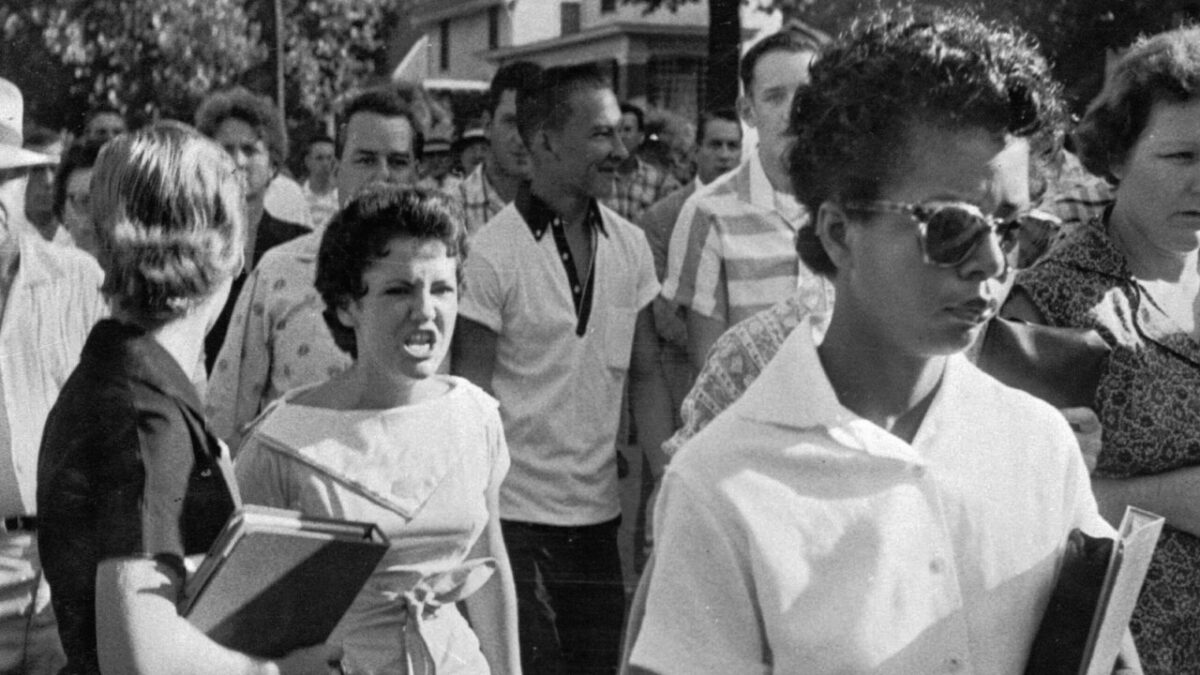
When Governor Orval Faubus used the Arkansas National Guard in 1957 to block nine Black students from entering Little Rock Central High School, he was not “standing up to Washington”; he was openly defying federal law and a binding Supreme Court ruling. President Eisenhower responded by federalizing the Guard and sending in the 101st Airborne to protect the students and enforce Brown v. Board of Education. That was not a coup. It was a President using lawful, constitutional power to make sure a state executive could not nullify federal law at the schoolhouse door.
A few years later, Attorney General Robert Kennedy confronted Governor George Wallace over desegregation at the University of Alabama, culminating in Wallace’s theatrical “stand in the schoolhouse door.” Once again, the federal government insisted that court orders meant what they said, and that state officials could not pick and choose which constitutional rights they would honor.

In those moments, a Democratic attorney general and a Republican president understood something basic: a governor who uses his office to obstruct federal law is flirting with insurrection, not defending “states’ rights.”
Civil War–era critics often point to Abraham Lincoln’s suspension of habeas corpus and declaration of martial law as proof of an overreaching executive. The reality is more complicated. Lincoln did push the edges of his authority in the opening months of the war, but Congress quickly moved to put those measures on statutory footing through the Habeas Corpus Suspension Act, which explicitly authorized the president to suspend the writ in certain circumstances and indemnified him and his subordinates for prior actions.
In other words, what started as a contested exercise of emergency power became a legislatively ratified tool in the context of actual rebellion. Whatever one thinks of Lincoln’s prudence in specific cases, there is at least a coherent legal framework: an existential civil war, an explicit act of Congress, and a Union government trying to hold the country together against organized armed secession.
That history bears little resemblance to today’s mayors and governors who simply refuse to cooperate with federal immigration enforcement because it is politically advantageous not to. I am sure legal experts will give a more nuanced argument than my more holistic review of history
Consider the record of deportations under President Obama. His administration removed roughly 2.7 million people, more than any other in recent decades, and did so under the same basic statutory authority that ICE and DHS rely on today. His own base labeled him the “deporter in chief,” yet the media class largely treated these removals as routine exercises of federal power.
Today, when ICE agents seek to execute lawfully issued removal orders, they increasingly find local jails and city governments actively shielding criminal offenders from transfer to federal custody. That is not a policy disagreement about priorities; it is a conscious effort to nullify federal law while leaving federal officers to chase dangerous individuals through public streets and private neighborhoods.
In my medical opinion, if we insist on using diagnostic categories, the pathology does not lie with the officers carrying out congressionally authorized duties. It lies with local authorities who are deliberately disobeying the law to manufacture a narrative of federal “overreach” that collapses under even modest scrutiny
The word “insurrection” has been shouted from the rooftops since January 6, 2021. Congressional committees and partisan commentators have used it as the gravest possible label for an attack on constitutional order. If that is the standard, then a governor or mayor who systematically frustrates the execution of federal law—whether on civil rights in 1957 or immigration enforcement today—is walking down a disturbingly similar road.
You cannot claim that one group of Americans is guilty of “insurrection” when they interfere with federal authority you happen to support yet stay silent when public officials sabotage laws you dislike. Either coordinated resistance to lawful federal power is a serious constitutional problem—or it is merely a talking point. It cannot be both, depending on the party in power.
What we hear instead is deafening selectivity. When federal power was used to enforce desegregation, it was celebrated on the Left as moral courage. When federal power is used to enforce immigration law under a Republican or less fashionable Democrat, it is denounced as cruelty or authoritarianism. When local officials undermine that enforcement, the same voices that once cheered Eisenhower and Kennedy suddenly fall mute.
Our politics today are saturated with words meant to end conversations rather than start them: racist, fascist, sexist, Nazi, insurrectionist—hurled ad nauseam by politicians and media figures who know that branding an opponent is easier than answering an argument. Once those labels are applied, meaningful dialogue is effectively taken off the table.
We have been here before. We have seen Presidents send troops to protect schoolchildren and uphold Supreme Court rulings. We have watched an administration carry out record numbers of deportations under laws passed by Congress. We have lived through a civil war in which the limits of executive power were tested, then brought under statutory control.
The question now is whether we are still capable of arguing about these hard issues with logic instead of raw emotion. Are we willing to ask, calmly and honestly, who is actually following the law and who is profiting by defying it? My hope—and my prayer—is that tomorrow we choose argument over accusation and constitutional order over partisan theater, while there is still time to do so.



One reply on “From Little Rock to Wallace’s Schoolhouse to the Streets of Minneapolis”
When you have a couple of generations of school children who were NOT taught the Constitution but were instead indoctrinated with Marxist rhetoric, this is how you end up.