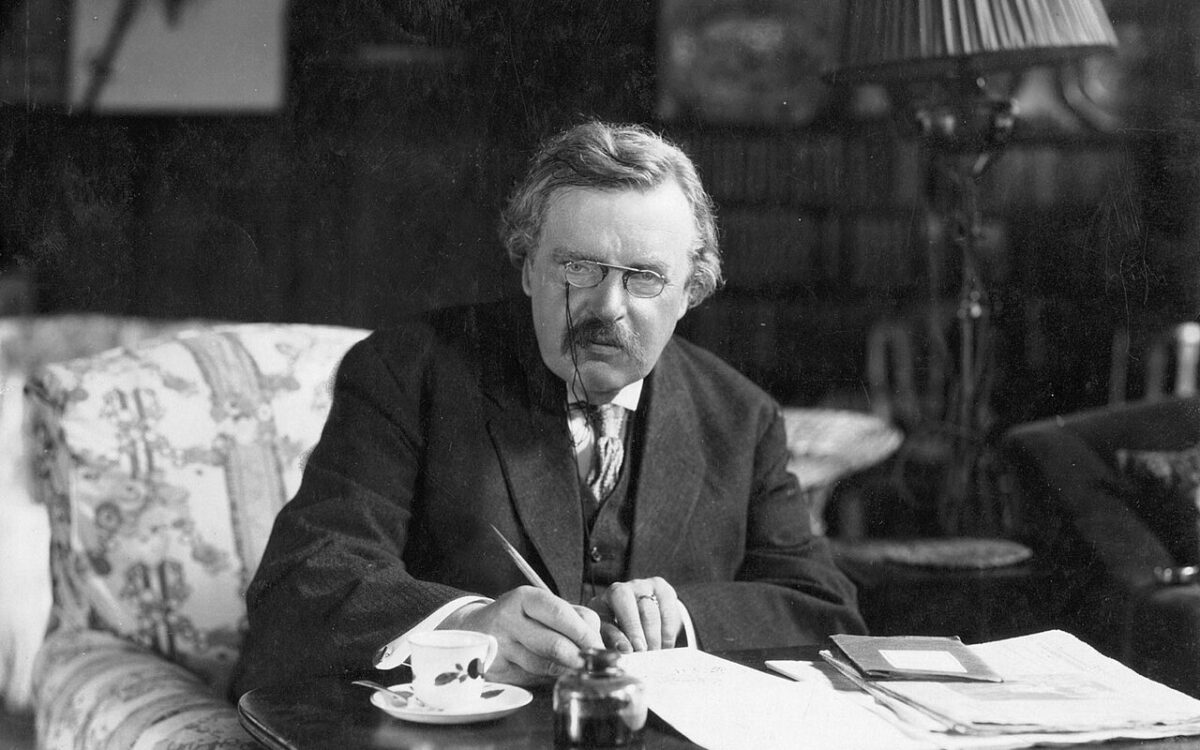
While I was still in college, my father sent me a poem by one of my favorite Christian apologists, G. K. Chesterton. Entitled “Lepanto,” it was written in 1911 to commemorate the naval battle of October 7, 1571, when the Holy League’s fleet, commanded by Don John of Austria, defeated the Ottoman Muslim fleet.
My father’s gift has stayed with me—not simply as a stirring account of a battle, but as a meditation on what makes a civilization worth defending.

Chesterton’s poem is not a conventional historical narrative. It is a dramatic vision of the survival of Christian civilization and the renewal of the chivalric spirit. Its soldiers, rulers, military commanders, and religious authorities serve as moral symbols. At its center stands Don John of Austria, whom Chesterton presents as something like the last knight of Europe: a man prepared to act when others hesitate.
The poem’s central theme, as I read it, is that a civilization remains alive when its people still believe something is worth defending, even at the risk of defeat. Chesterton gives that conviction memorable expression:
“It is he whose loss is laughter when he counts the labour worth.”
Here, courage is not the certainty that one will win. It is the conviction that the cause justifies the risk.
That distinction matters in our own unsettled political season. Protest, political hostility, and arguments over the distribution of wealth raise questions that reach beyond particular candidates or policies. What gives a society its moral foundation? Where does human dignity originate? And what obligations follow from our answers?
For me, the contrast between the French and American revolutionary traditions helps frame those questions. I see in the American founding a recognition that rights precede government and that political power must answer to a moral authority beyond itself. The French Revolution offers a warning about what can happen when the promise of liberation becomes an attempt to remake society without sufficient restraint or respect for conscience and “the voice within”.
Neither tradition should be reduced to a simple slogan. Nevertheless, the underlying question remains: Can political institutions sustain liberty if the people who govern—and those who elect them—lack a durable moral foundation?
Chesterton approaches that question not through an abstract political argument, but through the suffering of human beings. The poem’s moral climax, to my mind, is not the defeat of a fleet. It is the emergence of the galley slaves into daylight:
“White for bliss and blind for sun and stunned for liberty.”
Their liberation reveals what the struggle was ultimately for. Beyond the banners, rulers, and competing powers stand persons whose dignity cannot be measured by their usefulness to the state.
Chesterton describes them as having:
“A hidden room in man’s house where God sits all the year.”
That hidden room is the heart of the matter. It suggests an inward sanctuary that political authority neither creates nor rightfully possesses.
My concern about the far left, including the Democratic Socialists of America, is that its emphasis on institutional solutions can obscure this distinction. Institutions matter. They can protect rights, relieve suffering, and restrain abuses. But they cannot substitute for conscience, nor can they manufacture the virtue upon which their own integrity depends.
The danger arises whenever a political movement treats the human person primarily as material to be organized, administered, or transformed. A government may promise justice while forgetting the inward freedom that makes justice meaningful.
As a Christian, I believe a political order that denies any moral authority beyond human will places liberty on uncertain ground. Power needs limits, and those limits must be more than whatever the powerful find convenient.
That is why this election season is worth engaging in—not through hatred or disorder, but through argument, voting, service, and the patient defense of principle.
A civilization survives when its people possess both moral conviction and the willingness to act upon it. For those of us who believe in the voice within—in Chesterton’s “hidden room”—participation in public life is a moral responsibility.
Victory is never assured. Our responsibility is to discern what deserves defending and then to defend it faithfully.
That is why this election season is worth engaging in—not through hatred or disorder, but through reasoned argument, voting, service, and the steadfast defense of principle.
Institutions matter, but they cannot supply the conscience of the people who sustain them.
A civilization endures when its people believe that something is worth defending and have the courage to defend it, even at the risk of defeat. For those of us who believe in Chesterton’s “hidden room,” participation in public life is more than a political choice. It is a moral responsibility.
WE must all vote this election season. The march toward liberty that runs through Athens, Jerusalem, Magna Carta and our own Great Declaration runs straight to the voting booth. Candidates who understand and support this tradition deserve our vote and support.
The poem my father sent me in college still speaks to that responsibility. We cannot know whether we will prevail. We can decide whether the cause is worth our labor—and whether we will do our part.