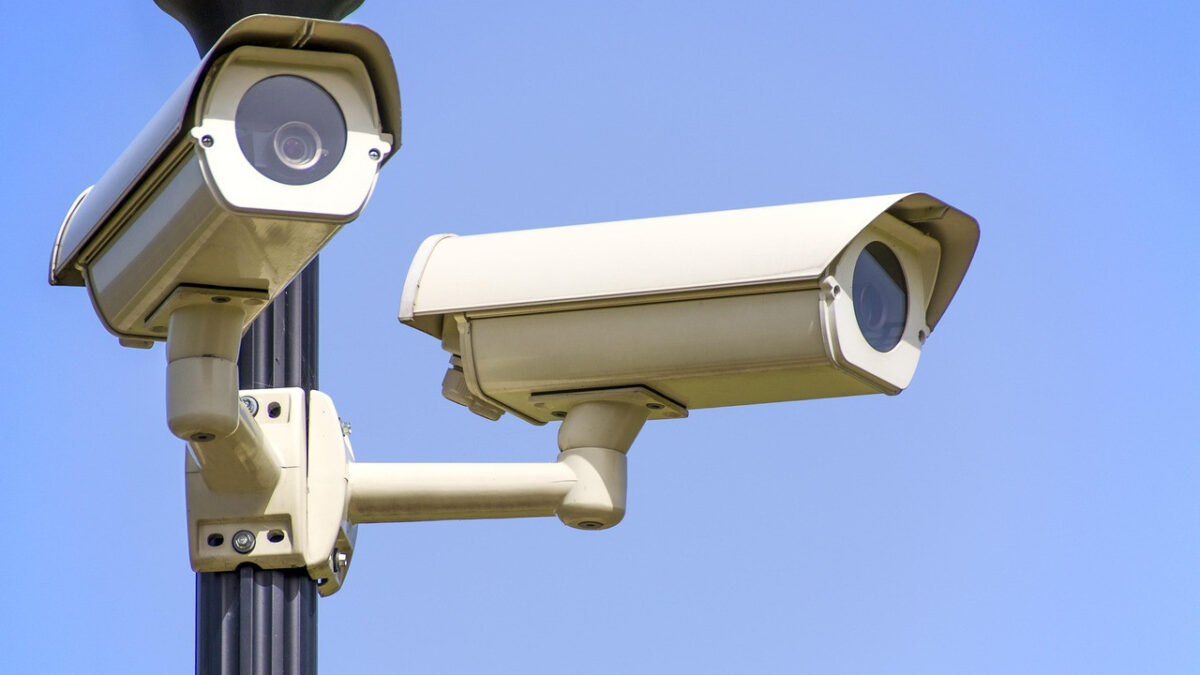
Surveillance on Americans continues to grow with expanding technologies doing the work. Without consent, information on individuals is collected and shared. Cases of privacy violations are ongoing and there is one technology that needs to be stopped.
Founded in 2017, Flock Safety created technology that describes itself as assisting in crime prevention. The technology includes AI-powered surveillance systems with license plate readers (LPR) that capture high-resolution still images of a car’s make, model, color, and plate details; AI-powered video; drones; and gunshot detectors. These technologies are not the same as other traffic cameras with different functions, but still serve surveillance roles. Flock surveillance reaches into billions of license plates across the U.S. The cameras can be found along roads, intersections, or entrances to neighborhoods. Once its software captures the data, it compares it to law enforcement databases for crime alerts, but the sharing of information is growing.

For law enforcement, this type of surveillance is supported and used because of its help with both detecting and preventing crime, and with investigations. Joining with security cameras in homes, Flock surveillance expands even further.
Funding for Flock includes backers such as the venture capital firm Andreessen Horowitz and Founders Fund in which Peter Thiel is attached. According to the World Economic Forum (WEF), Horowitz is “building the future through technology” and it partners with WEF on other surveillance projects that lead to control over society. It is no surprise that Thiel’s Palantir corporation is also a WEF partner.
An investment of $275 million dollars into Flock for “public safety” will include a platform that analyzes multiple data sources for help with investigations; U.S. made drones for real-time crime responses; data integration for full interoperability; and increasing the manufacturing of these technologies.
Just prior to this investment, Flock Safety had already released its new data integration program, Flock Nova, which “connects those systems and others, such as jail data, LPR, OSINT, and public records, into one fast search.” Literally, it is the mother lode of all databases being combined into one. “Search Once. See Everything.”
While Flock Safety founder Garrett Langley claims it is “technically impossible” for Immigration Customs Enforcement (ICE) to access data, that is not necessarily accurate, which Langley admits. However, his objective assignment of that violation as merely choices on the part of the parties who share the information is unacceptable. Access may not be obtained directly as he states, but rather through third parties that hold the data. Langley doesn’t seem to understand the ethics of this whole issue. However, his technology isn’t the only source for obtaining information.
In this video, up to around the 13:19 mark, Benn Jordon explains what Flock tracks and how that information is shared. The rest of the video is a technical look at how to protect yourself from Flock surveillance. He also has some ideas about obtaining Flock camera information in this video.
The American Civil Liberties Union (ACLU) has been taking a closer look at Flock use and its violation of the right to privacy. Citizens are also challenging Flock’s use in communities, and losing. States are once again having to create legislation to protect citizens from this invasion of privacy.
This type of surveillance isn’t enough for WEF, it wants to include AI satellite technology for “safety“ reasons and is part of another United Nations (UN) initiative. The transformation to this technology is already underway with roadside assistance programs.
As usual, more citizen power is needed these days to rid their lives of unconstitutional activities. DeFlock is a mapping website of Flock cameras around the United States and are listed on this map. Clicking on the camera icon brings up a box, but to view the exact location of the camera, click on “View on Osm” inside the box. Clicking on the colored circles with numbers will zero in on places where there are larger numbers of cameras, usually in cities. More information can be found here.
Flock isn’t the only business selling this technology. DeFlock lists different vendors that sell this technology and images of those cameras. DeFlock obtains its information from citizens and when these LPRs are discovered, DeFlock wants them added to its map here.
Langley doesn’t think much of Deflock, describing it as a “terrorist organization” at the 2:42 mark in this video. In that same video at the 2:51 mark, Benn Johnson discusses and how those cameras can be hacked and personal information stolen.
There is now a nationwide campaign by the Institute of Justice (IJ), a nonprofit, public interest law firm, to stop the use of LPR cameras. IJ litigates cases, advocates for legislation, and helps activate communities.
Children’s Health Defense is also addressing the LPR issue. In this video, starting at the 33:55 to 1 hour mark, Flock is discussed in more depth. The template for what information to request in a public records request (PRR) for local and state governments can be found here. Local and state governments often have their own forms, while a FOIA is for the federal government. The script for addressing your city council to remove Flock or other LPRs can be found here.
The purpose of the government is to protect our rights, but now, once again, it is up to us.

One reply on “Road Surveillance”
Those who would give up essential liberty, to purchase a little temporary safety, deserve neither liberty nor safety.
Benjamin Franklin
As a Nation, it seems we haven’t simply given up liberty, we have thrown it away. all so that we can indulge ourselves in our pet sins without supposed accountability. We’re beginning to see the bill for this choice and it’s going to be costly.