Matthew 7:3–5 asks why we notice the speck in a brother’s eye while ignoring the log in our own. It is a question about hypocrisy, but also about responsibility. Before we condemn others for tragic outcomes, we must ask how our own failures—political, institutional, cultural—helped lay the tracks that led to those moments of crisis.
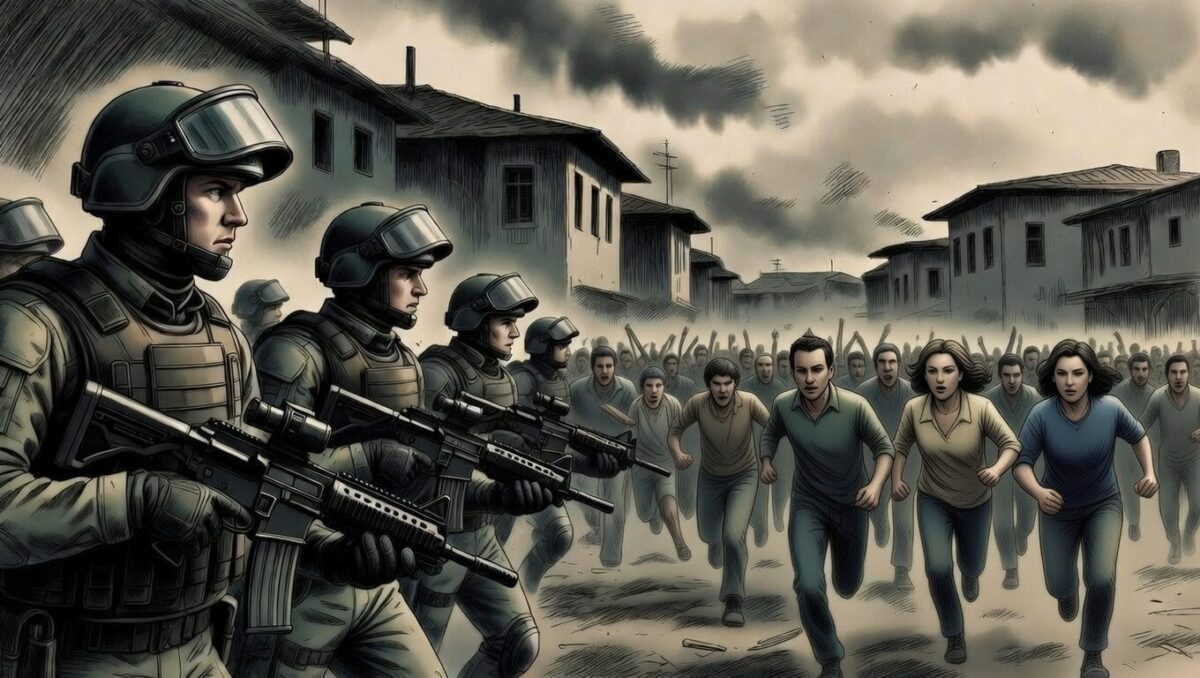
On two cold January days in Minneapolis, two civilians were killed during ICE enforcement operations. Federal officials quickly characterized both shootings as acts of self‑defense, while bystander video and statements from city leaders cast doubt on those assurances and inflamed an already polarized climate. The result was predictable: dueling narratives, outrage on all sides, and the familiar rush to assign blame to individual agents or to the “other” political tribe. What has been largely missing is the harder work of asking how the larger system of law, policy, leadership, and public culture failed long before any trigger was pulled.

Most traditional investigations stop at the level of the individual: did the agents violate criminal law, departmental policy, or established use‑of‑force standards? Those are necessary questions, but they are not sufficient. In medicine, aviation, and other high‑risk fields, we have learned—often painfully—that focusing solely on individual fault can actually obscure the deeper causes of bad outcomes. The better question is this: how did the system as a whole lose control, so that these deaths became possible, and perhaps even likely?
I spent 47 years practicing medicine and surgery in both the U.S. Navy and the civilian sector, in Virginia, Florida, Ohio, and Idaho. For the last two years of my active‑duty career, I served as Chief of Surgery and Director of Clinical Services at the NATO hospital in Keflavik, Iceland. There I worked closely with the aviation community—Navy and Air Force—and saw up close an approach to risk management that stands in stark contrast to the blame‑shifting and emotional posturing that now dominate our public debates about law enforcement and immigration.
In both the military and civilian worlds, physicians have historically spent far too much time deflecting blame from themselves and far too little time rigorously examining the systems that contributed to bad outcomes. Surgical morbidity and mortality conferences once were no‑holds‑barred forums where a surgeon’s decisions, techniques, and assumptions were subjected to relentless scrutiny. I dreaded presenting my own cases, and it never got easier. But those sessions made us better and saved lives. Today, far too many of those conferences have been transformed into risk‑managed exercises dominated by administrators and lawyers, focused less on learning and more on liability, reputation, and regulatory compliance.
In the mid‑1990s, Nancy Leveson, a professor at MIT and the University of Washington, helped pioneer a different way of thinking about accidents and failures in complex systems. Her work led to STAMP (System‑Theoretic Accident Model and Processes) and STPA (System‑Theoretic Process Analysis), now used widely in aviation, healthcare, energy, and other high‑risk industries. These approaches do not excuse individual responsibility, but they insist that we ask a deeper question: by what chain of design choices, policies, incentives, training gaps, and cultural norms did a human being end up in a position where one bad decision could have catastrophic consequences?
CAST (Causal Analysis based on System Theory) is an accident‑analysis method built on STAMP. Instead of rummaging around for a single “root cause,” it examines a hierarchy of controllers and feedback loops—laws and regulations, agency policies, supervisory structures, technology, training programs, and front‑line decisions—to understand how inadequate control allowed a loss to occur. Crucially, it is designed not only for mechanical failures, but also for “social losses” and organizational harms where simplistic blame‑seeking actually interferes with learning.
By that measure, the ICE shootings in Minneapolis are sadly textbook cases for a CAST‑type analysis. A serious inquiry would start by identifying three core elements: losses, hazards, and safety constraints. The losses are clear: the death of civilians during enforcement operations, physical and psychological harm to bystanders and officers, and a further erosion of public trust in both local and federal law enforcement. The hazards include armed or perceived‑armed confrontations in densely populated areas; operations in which federal agents lack reliable local intelligence or support; and ambiguous or conflicting rules of engagement in a context already charged by protest, fear, and political theater.
From those losses and hazards, we derive safety constraints: conditions that must hold if such tragedies are to be prevented. Among them, that ICE and local police conduct operations in ways that ensure lethal force is used only when a reasonable officer would see an imminent threat of death or serious injury, under both Minnesota and federal standards. That operational planning avoids foreseeable situations in which agents are likely to misperceive phones, sudden movements, or vehicles as lethal threats. And that communication between federal and local authorities is robust enough to prevent operations from taking place in environments that are, by design, primed for misunderstanding and escalation; designed to create mystery and support a political narrative.
Notice what this framework does. It does not tell us whether a given agent’s split‑second decision was criminal, justified, or something in between. That remains a separate legal and moral judgment. What it does insist upon is that we step back from our tribal emotions and use tools of logic and reason. Whether we are jurors, surgeons, engineers, or citizens trying to understand a fraught event, the question is not only “Who is to blame?” but “How do we keep this from happening again?”
There were many steps that led to these two deaths. Some were on scene—tactics, communications, split‑second judgments by agents and civilians alike. But others were upstream and cultural. We do our children and our communities no favors if we refuse to say aloud something that should be obvious: one of the surest ways to reduce the risk of tragedy is not to engage in confrontational behavior with armed authorities during volatile situations where everyone is on edge and miscalculation is one heartbeat away.
If you end up dead, it doesn’t matter who was right or what was legal. The tragedy in such cases is that it could have been avoided.
Yet it is not enough to lecture individuals about compliance while ignoring the “logs” in the eyes of our leaders. For at least three decades, Congress has refused to do the hard work of fundamentally updating our immigration laws, leaving a patchwork of statutes, executive improvisations, and litigation that practically guarantees confusion and conflict on the ground. The executive branch, across administrations, has lurched between laxity and crackdowns, sending mixed signals to both migrants and enforcers. In recent years, millions have crossed our borders without meaningful vetting. Many seek only safety and opportunity. But when vetting is perfunctory or nonexistent, we cannot know how many criminals or hostile actors have also entered. That uncertainty breeds fear, and fear distorts judgment in the field.
At the local level, mayors and prosecutors in parts of Minnesota and elsewhere have adopted policies that, whatever their stated motives, effectively nullify federal immigration law. When local officials declare themselves proudly unwilling to cooperate with federal enforcement, they do not abolish the law; they merely drive a wedge between agents and the communities in which they must operate. That tension makes every encounter more volatile. It invites the very sort of tragedy Minneapolis has now endured. In the rush to call federal agents “insurgents,” we might pause to ask whether the more destabilizing form of rebellion is the systematic decision by local leaders to defy duly enacted law while basking in the applause of their political base.
Still, even here, we must not content ourselves with indignant finger‑pointing. Almost none of us have stood in the place of an agent who, in a split second, believes his or her life is in danger. It is deceptively easy to judge those moments from the safety of a couch or a studio, rewinding video frames and issuing verdicts in slow motion. The harder, more honest question is: what would I have done, in that instant, with that information and that fear? Most of the Monday‑morning quarterbacks dissecting these shootings have never worn a badge, faced a mob, or executed a high‑risk warrant. That does not mean they have no right to question or criticize. It does mean their critiques should be tempered with humility—and informed by a willingness to examine their own role in supporting leaders, narratives, and policies that make these disasters more likely.
The agents in Minneapolis may or may not have made legally justifiable choices. Investigations and courts will decide that. But long before either trigger was pulled, those agents were failed by a political class that would rather posture than legislate, by media enterprises that would rather inflame than inform, by local officials who would rather signal virtue than coordinate for safety, and by a civic culture that too often prefers outrage over understanding. Before we fixate on the speck in the eyes of two ICE agents, we might first reckon with the log of systemic failure lodged in our own.

2 replies on “The Logs in our Eyes”
My bias is that of a retired LEO. Until you are in a position where a split second of hesitation can get you killed it is almost impossible to understand these outcomes. The bottom line is that illegal is illegal. We are either under rule of law or we are not. The other significant point is that the anti-Ice movement is a highly organized insurgency. The choice to be made is if we can or even should avoid a civil war.
There is a difference between a rebellion and an insurrection. The first is grounded on a moral predicate, the second is grounded in chaos.